Article by HorsePower
By now the statistics are surely familiar. Up to 90% of Thoroughbreds in training
show signs of Equine Gastric Ulcer Syndrome EGUS on endoscopic examination of
the stomach lining. The Syndrome, previously thought to be one entity, is now
separated into two types, ESGD Equine Squamous Gastric Disease and EGGD
Equine Glandular Gastric Disease affecting the upper squamous part and the lower
glandular part of the stomach respectively. The causes and treatment of the two
types are somewhat different, but stress and acid attack of the stomach lining are
common factors.
The EGUS we see in Thoroughbreds is caused by human interference in their
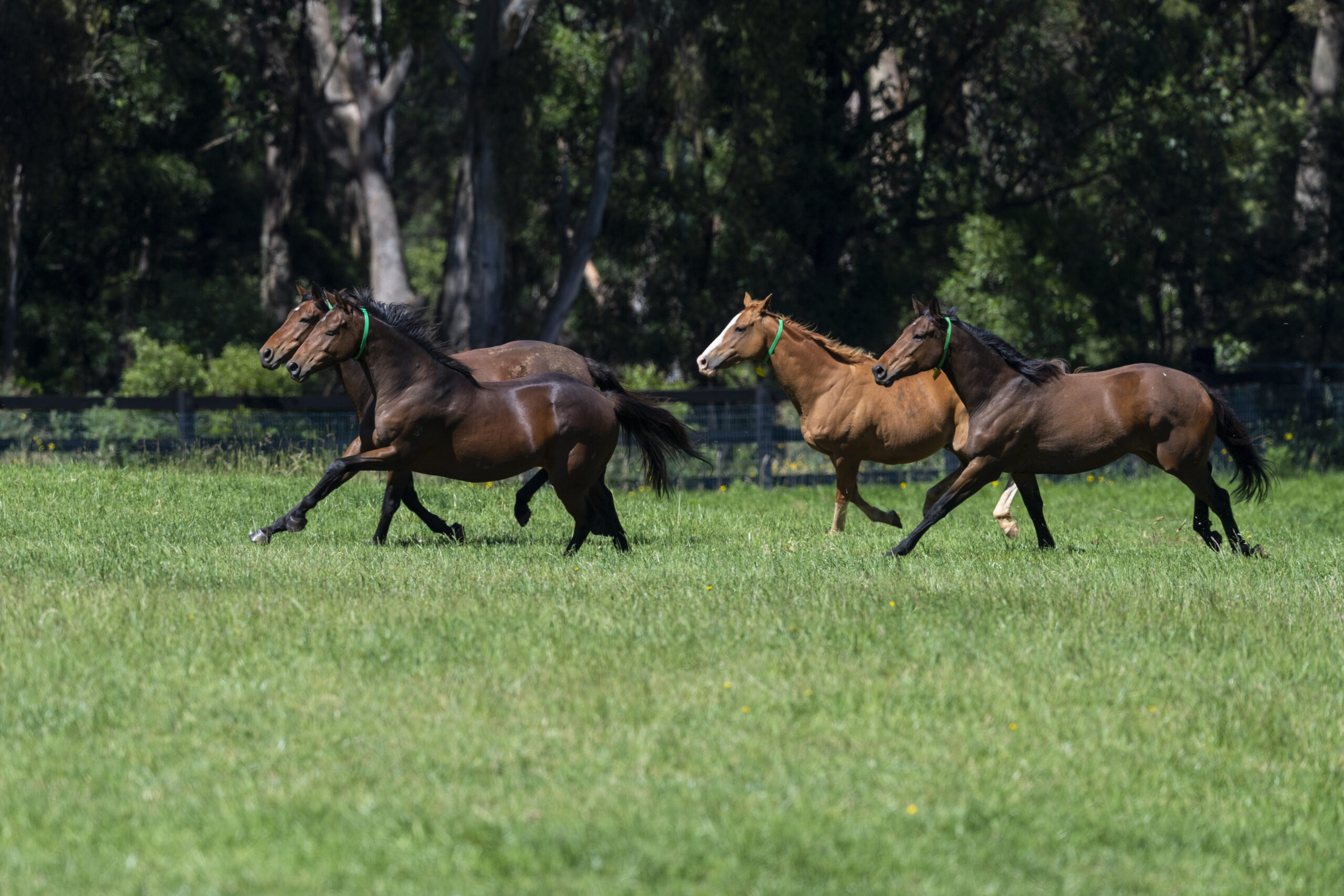
natural way of life, namely, to wander around grasslands with their mates eating
forage for around 18 hours every day. Wild horses do get ulcers but less so and
thought to be associated with drought-driven feed scarcity, or periods of stress during
breeding etc.
The factors predisposing to EGUS are many and varied but these are the most
important:
*Reduced forage intake and intermittent feeding causing excess stomach
acidity and lowering gastric pH
*High energy, high starch grain- based diets
*Stress.
*Exercise on an empty stomach causing acid splash onto the upper stomach
So, if we wanted to induce EGUS in a Yearling for example, we would take it out of
the paddock where it enjoys grazing all day and chilling out with its yearling buddies,
put it into a stable all by itself alone, feed it some high energy concentrates, start
handling and continuing their education process (necessary but stressful) and put it
on a walker first thing in the morning then feed it 2-3 times a day with just enough
hay included to last it about an hour. Oh! And we don’t do anything to stop the acid in
its empty stomach burning holes in the lining either.
Job Done. We have ulcers. Then we give it Omeprazole. To fix the ulcers we just
caused.
Then, in a couple of weeks or more we stop giving Omeprazole because hopefully
the ulcers are fixed, and it’s expensive. Then in another couple of weeks or more the
ulcers are back again because the same things which caused them in the first place
are still happening. Which is why most Yearlings going through sales prep wind up
with EGUS. Hardly surprising really. Cause and effect.
So, whilst Omeprazole is the cornerstone of treatment for squamous disease and
used in combination with Sucralfate for the glandular type, is there anything else we
can do to help avoid recurrence of these wretched ulcers?
There is now.
Back in May 2026 Horsepower became aware of trials of a French product written up
in a peer reviewed veterinary journal which showed promise as a gastric acid buffer
– something which neutralises gastric acid. The base chemical was not new.
Magnesium Oxide has been around almost as long as indigestion, but like ‘Soils ain’t
Soils’ this Mag Oxide was different. The company preparing it, was expert in all
things related to Mag Oxide, mining it in Brazil and Spain for multiple different
applications.
The product they developed relied on combining a wide variety of different particle
sizes, down to almost nano particle size mixed with larger particles to dissolve and
neutralise acid at widely differing rates. The tiniest particles act fast, the larger ones
more slowly, extending the effect for several hours.
Marketed in France it was well researched both in the lab and in field trials where it
achieved a significant reduction in ulcer scores in two properly constituted trials of 40
horses. Horsepower obtained all the relevant trial data and corresponded with the
French to verify everything and then worked with the Australian distributor of the
active raw material to secure a supply.
It was decided that a pellet would be preferable to a powder form for ease of use and
particularly to enable it to be fed first thing in the morning, along with some hay,
before exercise to horses in race training. The hay first idea is important as it forms a
mat in the stomach which reduces acid splash onto the upper part of the stomach.
First trials here bore out the hoped-for results, and the product was released on the
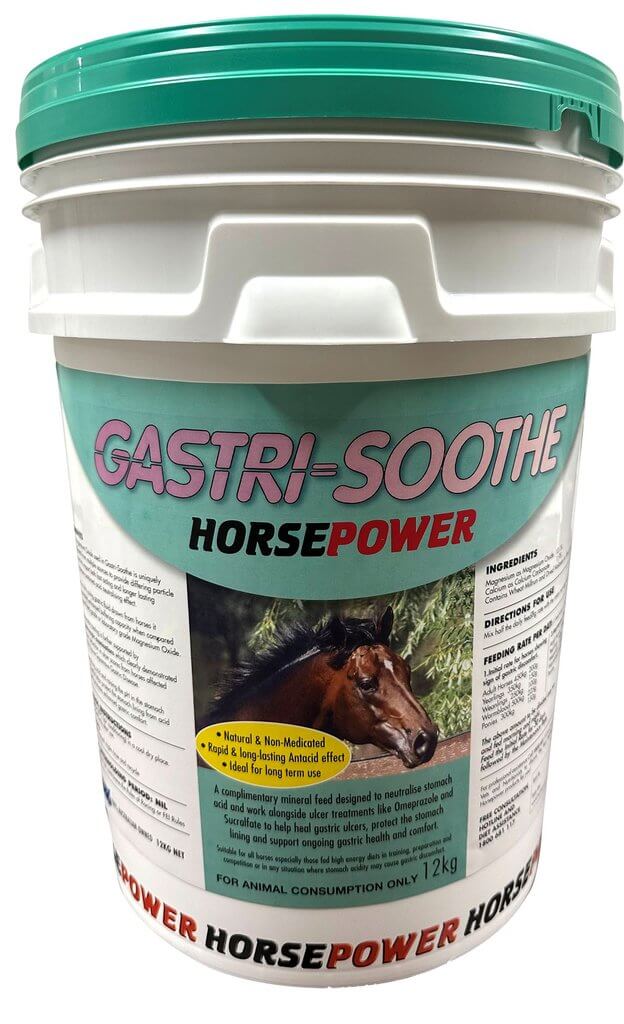
Thoroughbred Birthday as Horsepower Gastri-Soothe with twice daily feeding to
extend the acid buffering through the night when forage feed may become
unavailable. Whilst not an ulcer treatment per se like Omeprazole the aim is to raise
gastric pH and thereby help protect the stomach lining from acid attack and improve
gastric comfort.
The feedback to date has justified the time and effort expended, for example:
“First 2-3 weeks of spelling, on ulcer paste, the horse put on 12kg. The next 2-3
weeks, no ulcer paste but on Gastri-Soothe, put on 27kg.”
“After 10 days on Gastri-Soothe the horse who is a bit on its toes had firmed up in its
droppings and went to a local show where it was noticeably calmer and paraded
better.”
“We put a colt on it who was scoury and generally behind the 8 ball. In 2 weeks,
horse’s manure had firmed up and when they took the rug off were amazed by how
well he looked.”
“I’ve tried it on AAAAAA and BBBBB as they’d been on a similar supplement. I like it,
their appetites have been good and demeanour improved on AAAAAA so I’ve
ordered some more”
“Their appetites have been really good and the demeanour on the older horse has
definitely improved”.
“I’m definitely keeping her on that stuff -its good s#@*. I’ve put another one here on it
as well and these horses are just licking the f#@&! bin clean every time – and they
never do that!”
The main feedback has been improved appetite and demeanour both of which we
believe related to reduced gastric discomfort, and horses with soft, cow-like manure
firming up and having normal droppings. This mimics the French experience.
So, having contributed to EGUS with our feeding and management practices, we
need to look at prevention as well as cure. Increasing the time forage feeds are
available, not exercising on an empty stomach, reducing stress where feasible are all
part of that. Endoscopy for diagnosis and Omeprazole for treatment remain the gold
standard, but beyond that Gastri-Soothe offers a new tool to manage this condition
and actively soothe all those miserably sore tummies.
Reference. J Vet Sci. 2023 Nov;24(6): e27 Effect of a blend of magnesium oxide on
Equine Squamous Gastric Disease in young trotter horses under training.
David T. Wood BVSc. MRCVS.
Visit the Horsepower website here.